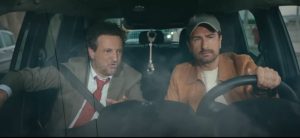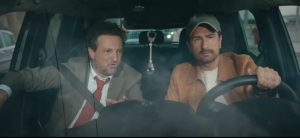
“In many of my films the characters fight from a disadvantage, I don’t think they’re losers though,” said Gus Van Sant in reference to Tony, the protagonist of the blackmail. Dead Man’s Wire, his new film, presented at the 82nd Venice International Film Festival, out of competition. Released today, it is inspired by a true story: Tony Kiritsis hostages Richard O. Hall, the son of the owner of an insurance and mortgage company, to erect a public podium from which to denounce capitalist speculation and its processes of marginalization.
Van Sant is a master in subtraction and discretion. His cinema is an investigation into marginalization and isolation, especially in youth. It is no coincidence that the thread of blackmail. Dead Man’s Wire was also promoted through an AMA (Ask Me Anything) session on Reddit, a platform frequented mainly by teenagers, conducted in early January. The director, along with screenwriter Austin Kolodney, discussed with users about the film and the production of the author. The protagonist of Il filo del ricatto. Dead Man’s Wire is isolated and distracted by the country with stars and stripes, as well as Van Sant during his childhood, followed by his father committed traveler, among the inconveniences and American extromissions. This is how the director knows and anticipates human unrest and transforms them into a sensitive, real and deeply independent cinema.
Van Sant approaches the cinema during the student period at the state-of-the-art art school Rhode Island. He then decided to move to Hollywood, where he began his anti-conformist career with a provocative look on the film industry with Alice in Hollywood, a media film in 16 mm never released. Retracing the stages of his career, the director ironed on the project: “I believe, that didn’t work well: history, script, realization and concepts,” says the filmmaker during a lesson on creativity. “I remember that we projected it in New York, it was on a videotape, and we organized a small party for the film, but it was in a room where a room was dedicated to the screen and the next one was dedicated to drinks. Slowly everyone moved into the room with drinks while the film continued to be projected.”.
Despite the first failure, Van Sant becomes a point of reference for independent directors and, starting from Malanoche (1986), his debut feature, inaugurates a series of stories, different from each other but firmly consistent in the representation of disturbances and escapes from life. Within a few years he made two films become cult: Drugstore Cowboy (1989), where Matt Dillon is the swirling portrait of addiction, unstable and with rapid enlargements, as well as the mdp of Van Sant, and Belli and damned (1991) with Keanu Reeves and River Phoenix, testimony of empathy for lost American youth and became a landmark of the New Queer Cinema. The film is sadly known to be the last film before the tragic disappearance of Phoenix, to which Van Sant dedicates the following work and, twenty years later, a documentary co-directed with James Franco, My Own Private River.
“Because I didn’t have brothers, I was always interested in the children who lived at the bottom of the street and who had four brothers in their family, so I became one of them. I’ve always been attracted to temporary families. They tend to be lost characters.” This is the spirit with which the director illuminates groups of people ignored by traditional cinema in a funky, powerful and extravagant way. It will be a case, but the greatness and sensitivity shown in the works belong to Gus Van Sant before the adolescence and the victories up and down to America. The dichotomy that accompanies his cinema is already in the name of baptism (Gus), both diminutive of other male names like Augustus, Gustav, Angus, and derived from the great word. Thus, Van Sant produces films in which the angry protest emerges against the system but also a certain class and delicacy; just mention the double cameo of William s Burroughs, in Drugstore Cowboy and Cowgirls the new sex (1993), overflowing compilation of American counterculture with a fantastic Uma Thurman before becoming Mia Wallace and below Beatrix Kiddo.
With Da die (1995) the director closes the parentheses of this first stage full of creativity and pop colors. In these years Van Sant also produces music videos for David Bowie and the Red Hot Chili Peppers (we welcome the video of Under the bridge, perfect also as a soundtrack of his production) and approaches a more tracked and therefore accessible cinema, while remaining faithful to the restless looks and the glaring bodies of the excluded. Will Hunting – Rebel genius (1997), Oscar award for best original script (Matt Damon and Ben Affleck) and best non-star actor (Robin Williams), and then Scoprendo Forrester (2000), make an opener to a poetic closer to the general public, which later, Van Sant continued to propose leaning on great actors. He refers to films such as Milk (2008), where he receives an Oscar nomination for directors (and with whom Sean Penn will win for the second time the statuette as best actor and Dustin Lance Black best screenplay); Promised Land (2012) with Matt Damon and Frances McDormand; The dream forest (2015) with Matthew McConaughey and Naomi Watts; Don’t Worry, He Won’t Get Far on Foot (2018), with the excellent acting test of Joaquin Phoenix and Jack Black.
Among the two Oscar films, there is perhaps the most interesting and evocative phase of Louisville’s director: a cinema that is existentially slow that enhances Van Sant’s sensitivity in intercepting difficult social issues and making them deafening with discretion and finesse. Gerry (2002) is a bet with the viewer, the opposite of the horror vacui and a wonderful blend of boredom and existentialism in Death Valley in California. Elephant (2003) discusses the Columbine massacre of a few years earlier, with anti-moralism plans in the middle field that give him, surprisingly, the Palme d’Oro in Cannes. Finally, Last Days (2005), inspired by the story of Kurt Cobain, is accurate and effective in representing the solitude and mental illness of the last days of a young musician. To these, which make up the so-called “Trilogy of Death”, is undoubtedly added Paranoid Park (2007), the story of fear and restless teenage of an aspiring skater named Alex who seems to be involved in the murder of a security guard.
Following the degree of sensitivity of what has become a quadrilogy, you could extend the number of works to five and also insert the magnificent Love that remains (2011), for us of Sentieri Selvaggi the best movie of 2012, composed of “corpi that meet, they get caught, they dissipate” between life and death.
Cineasta from the remarkable degree of acume, Gus Van Sant, is also known for its frame-by-frame remake of Psyco. Pshyco by Van Sant, in addition to a great tribute to the Hitchcock master, is a postmodern experiment of kinephile arguzia still difficult to decipher, with Vince Vaughn as Norman Bates.
Gus Van Sant is finally a multifaceted artist. The filmmaker’s career is also accompanied by painting, photography and music. He also directed several advertising campaigns; to recover OUVERTURE OF SOMETHING THAT NEVER ENDED, a web series that tells the poetics of the Gucci brand. His ability to represent marginalized subcultures is far more than praiseworthy and founding of the youth subculture of the 1990s. Van Sant does not wait for the characters but accompanies them. It is one with them and with the viewer, to which it offers a privileged vision, close but discreet at the same time. He does not fear the void but is also able to flirt with the mainstream. Never capricious and superficial, always deep and simple, has been able to map the invisible, giving dignity to silence, marginality and introspection.
L’articolo Gus Van Sant: mapping the invisible proviene da SentieriSelvaggi.