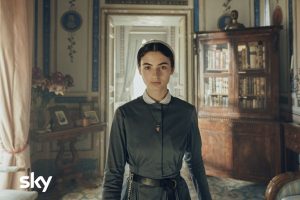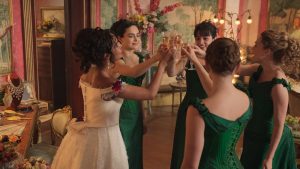
On 5 March he will arrive in the Brides – Young brides of Nadia Fall. We interviewed, exclusively, the dramatist and theatrical director, on the debut behind the camera with a film that includes and without judgement the uncertainties and teenage errors. With her we talk about the film, inspired by events that really happened, which tells the escape from the UK of two Islamic girls marginalized and rejected.
Brides – Young brides is inspired by a true story. How did you find it and what struck you to make a movie?
As you know, I’m a theatrical director and a few days ago I was performing a show at the National Theatre in London with the screenwriter of Brides, Suhayla El-Bushra, when many people in the world of cinema and television came to us saying: “Girls, you should make a movie. Your work is very cinematic.” At the time, there were so many stories about young people who had experienced similar experiences to those of our protagonists. There was a very famous case, that of Shamima Begum, who along with his friends in East London, all fifteen, had embarked on the journey to Syria (to join ISIS, ndr). Even today, almost every month, we feel another chapter in history. It never ends. We were fascinated and intrigued by the fact that the British press painted these girls as evil monsters, but we thought it couldn’t be so because they were just girls, teenagers. To be honest, we were also very scared. We didn’t want to tell the story because we thought we would only contribute to the stereotype that Muslims are violent or terrorist or something. But then we realized that the story would not disappear and that we had to tell it. We were really interested in their friendship and the reasons that led them to leave. We have done a lot of research on similar cases in Britain, but also throughout Europe. For me, Brides is really a road movie, a film about friendship, but also about belonging and the treatment that reserves society to people from different contexts, making them feel excluded from that world, and this is a very tragic and dangerous thing.
The protagonists are foreign to a place that should be home. Most of the film is set in closed spaces (school, mother’s apartment, airport and bus station) and gradually the setting opens until arrival in Syria. As you worked on the spaces also in relation to your theatrical path.
The story before the trip is set in a country on the coast of the United Kingdom where there are these cities, which already pour in difficult economic conditions, where immigrants or asylum seekers are placed. They’re really marginalized. There is no investment in schools, health and youth services. So there is this friction in communities, a racist friction that in some cases is fed by politicians, of course. But the place was really interesting because, being accustomed to the theatre, where everything is enclosed in a limited space, as an debuting director I felt like I was literally traveling. So we shot on the beautiful Welsh coast, then went to Turkey and then to Italy, where we shot most of the movie in Sicily. The realization of the film itself had already given us the feeling of being in a road movie. Although it was challenging, it was also very exciting and enriching and really helped the actors to tie. We turned to some of the places linked to the history we were inspired by. For example, the bus station is real and is the same where Shamima Begum and her friends waited for a bus from Turkey to the Syrian border. So yes, fiction met the life and real places, which was really exciting for the history of a road movie.
History deals with marginalization and bullying, which are common in the UK but also universally. How are you linked to these issues and how important it is to report them?
I think it’s hard to be young and try to integrate, to feel part of something. We all experience it: people of color, white, heterosexual or homosexual. We all have our identity and remember well how it feels to be teenagers. It’s really embarrassing. Your body is changing, you are ashamed of yourself and your mother and, in the film, you add the idea that you are not considered one of the place even if you were born and raised in a country. It’s very real and button. I also lived it growing. Although I feel completely British and I was born in London and typhus for England in rugby and football, my parents are Asian and in this country there are people ready to say that I am not British. This is very painful because we all want to feel part of something. So I think the movie says something about it. But for me cinema and theatre are also an empathy machine. And I’m not the kind of artist who wants to yell at you like a teacher, saying, “You think about politics. Think about the environment. Think about racism.” I just want to present a story with nuances and truths from which to draw personal conclusions. I feel very in tune with young people and their way of thinking. I like to observe their brain, which is programmed to make risky and impulsive decisions. We all did. That it was about trying a joint, going out late and not coming home, getting drunk or following a guy. We all make stupid decisions when we’re young and usually get away with it. We usually survive. Some of us don’t.
The impulsive decision of girls is to escape and join ISIS to escape their condition but the choice is almost marginal in the film.
Yeah, I don’t even know if they decided to join ISIS. I think they have decided to go to Syria to fight against the forces of Assad that oppressed their own people and that they have been united by the promise of a community, of sisterhood, brotherhood and freedom. I don’t think they really knew what they were doing and I think they were manipulated online. Both protagonists have different reasons to embark on the journey and I don’t think it serves a specific reason. Life is never like this. We of course know the horror that was on the other side (in Syria, ndr) because we are informed, but they do not. There is no freedom in Syria, but a chaos with different forces fighting each other. So it’s really a tragedy. But my story is not about what happened after that moment. It’s about the journey to get there. And I hope you ask the question: what if they didn’t leave? What if someone found out and took care of them before?
The film avoids any judgment: it never questiones the choice of the protagonists and, instead, focuses on deepening and exploring their fragility.
Yeah, I think this is the theme, the trip. I hope so, because in the end they are girls and, moreover, I do not think that a true artist can really judge the characters. You have to try a kind of empathy to understand the nuances of a situation and its dark aspects. Girls do not represent good or evil but simply two teens who embark on a journey. And I think the key to me is they’re girls.
Let me make a philosophical reflection. The film tries to understand the fragility of adolescence, but how far can it be understood? Or again, does it make sense and it is possible to judge?
I don’t know if judgment makes sense, but I think that just as we are obsessed with going to the gym or taking vitamins to live longer, and I think that one of the most important things we have to do for our health, as individuals and as a society, is the act of empathy. The ancient Greeks forced their citizens to watch theatrical performances. Even their slaves and even – God does not want (laughs) – their women. They looked at theatrical performances to discuss life in the world. Today we are dependent on this: from the phone, Instagram and social media. And we are hypnotized by what is not art for me, but it is a kind of addiction. It is a content that creates dependence. I think art, especially cinema and theatre, serves to exercise the muscle of empathy, to build it, to develop it as you do in the gym. And I swear it was my whole life’s work to prove that if you train that muscle, you become happier people.
Back to the relationship between cinema and theatre. How did you work on the composition of the image, coming from an artistic form that does not foresee it? How was your relationship with DoP Clarissa Cappellani and how much did you rely on her?
Cinema is a cousin of the theatre, not a twin. It’s much more visual. In the theatre we are obsessed with performance and text, but we have the opportunity to frame with light and sound and architecture. But you’re right, the cinema is definitely more visual and I have really entrusted myself to the brilliant director of Italian photography, Clarissa Cappellani, who is Sicilian but lives and works in Rome. The rest of his team was incredible: the audio department, the post-production, and the producers. Brides is a film that is truly a co-production with Italy. That’s why I hope you find an Italian audience. On the set I learned a lot: when it comes to theater I am an adult but when it comes to feature films, I am a child. And as an artist, I like being a child. I like being curious and not having all the answers. I learned a lot thanks to Clarissa and the Fiona Desouza, two figures that do not exist in the theatre. I am really happy to have had a director of Italian photography, because the taste of this film is definitely Italian and European. And that aesthetic might not have been possible without our partnership and collaboration. That’s why I’m really passionate about international collaboration: why we put together the best of our cultures and practices and together we create something really new. I hope I can do it again soon.
The article Brides – Young brides. Interview with Nadia Fall comes from SentieriSelvaggi.