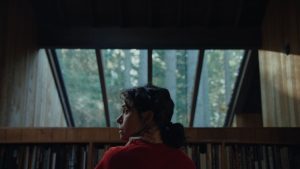
On Thursday 5 March, the Cinema Azzurro Scipioni hosted the Macedonian director Milčo Mančevski for a special screening of his Willow (2019). At the end of the film Mančevski dialogued with Claudio Siniscalchi and Ludovico Cantisani D’Auria on the work of Willow, the difficult working conditions he faces in Macedonia and his filmography.
The Azurero Scipioni, a cinema d’essai founded by director Silvano Agosti in 1983 and forced to close due to the pandemic and lack of state funds, reopened in May of 2024, resuming exhibitions and programming for cinema lovers. A room that warmly welcomed Mančevski, appreciating Willow, presented at the Film Festival in Rome in 2019, and underlining the courage that the director had in 2020 to denounce irregularities and corruption within the Macedon Film Agency. Exposing himself, he suffered a little censorship from the state, which excluded him from the country’s productive and cultural landscape, forcing him to shoot his films abroad. There was no lack of solidarity from the world film community, beginning with the Venice Film Festival.
Mančevski, born in Skopje in 1959, debuted in 1994 with the feature film Before the rain, winning the Golden Lion at the best film in Venice. He has alternated strictly Macedonian and in general European productions (Dust, 2001; Shadows, 2007; Mothers, 2010), also passing through the United States (Bikini Moon, 2017). By addressing both documentary and fiction, he investigates relationships between individuals, family and love, and calls and connections that could unite them through the centuries, cultures, geographies.
In particular Willow tells about motherhood, a theme, a desire to the basis of the biological continuation of the species. Here too are three stories that unfold and intertwine in the hundred minutes of the film; two historical periods in the background. In medieval Macedonia, two young lovers escape from their families, eager to seal their union by having a son. That unfortunately they cannot have so they turn to an elderly relative of her, considered a witch, who perceives a curse burdening on the couple. The witch promises them a large offspring as long as the first genius is given. Although set in contemporary Macedonia, the other two episodes and their protagonists seem equally afflicted by an invoice. A very in love couple seeks with so many efforts to become parents and once they succeed something goes wrong. The sister of her, with her husband – also unable to have biologically – adopt a child who despite the tender age has a conflictual relationship to the limits of the disturbing with the new mother.
Beyond time, geographies, cultures “people are always the same, with their existential dilemmas,” says Mančevski. More than maternity, what in the first instance moved the director in the realization of Willow was the desire to set a story in a historical period far from today, faithful to archaic beliefs. “It was very fun to do the research, perhaps even more than filming itself. I have deepened the behaviour of the Macedonians in the Middle Ages, starting from everyday gestures: if they shake hands, if they kissed, if women rose as soon as a man entered the room. I focused on detail to understand how people lived at that time.”.
In Willow maternity is a desire even before a vital function, the fruit of a biological fertility. It may not be a coincidence, therefore, that the only one of the three paintings that has a happy resolution, which gives the film its “most optimistic gesture of the film”, is precisely the last – that even in the beginning was simple rib of the second episode and only subsequently became autonomous and equally complex. The third protagonist is the only of the three women who will never succeed in bringing life into themselves but is always the only one who will be able to fill the role of mother, seizing in silence a relationship with his son, who puts aside anger and abandons himself to parental love.
Mančevski had imagined two versions of the film, a “male” and a “feminine”. If the second was projected at the Blue Scipioni, the first was presented at the 2019 Film Festival. “This idea was a game, a sort of experimental narrative exercise. The male version is faster, it has more narrative jumps, it goes straight to the point, and it is a little shorter in duration. It was a way to try to tell the story from two different points of view, with two different styles, to question, even after shooting, writing and editing the film, the narrative possibilities.”.
It would have been impossible not to mention the current working conditions of the director in his home country. Despite the media campaign against him, Mančevski continued and continued to write and make his films, producing himself and thanks to collaborators and friends from other countries. “I’m currently working on two new films for reasons of contempt: it’s my rival, towards the cinema mafia in Macedonia. The government stopped me from making movies for four years. Now after winning two cases in court, the situation has finally been unlocked.” For the first time, the director has experimented entirely with the genre of the documentary (if one does not consider the “real” shade of the third episode of Mothers). It is called Good People and tells of a stake in a disco and rescuers and survivors of the tragedy. The second project, Sister Brother Manhole Cover, is again a fiction film, between drama and comedy, on two brothers who to land the lunar steal Macedonian archaeological finds.
L’articolo Willow at Cinema Azzurro Scipioni: meeting with Milčo Mančevski proviene da SentieriSelvaggi.