Robert Davi is an Italian-American actor with more than forty years of experience across film, television, and stage. With over 170 credits to his name, he has appeared in films that shaped popular culture, including Licence to Kill, The Goonies, and Die Hard. Known for his intense screen presence and the “tough guy” charisma that made him unmistakable, Davi embodies one of the most recognizable figures of American cinema.
You have often played villains and powerful figures—characters who dominate the scene. What makes that power truly believable on screen?
As an actor, you don’t judge the character. That’s for the audience. Your job is to understand his choices and justify them. Even when they are extreme, they must have an internal logic. If you truly believe in it, the audience perceives that truth—and that’s where power comes from. I have always tried to give humanity to my characters. No one wakes up in the morning thinking they are evil. Everyone acts according to their own logic, their own wounds, their own purpose. When that truth is authentic, power isn’t something you impose: it becomes something natural. Power doesn’t necessarily mean shouting or imposing yourself by force. Sometimes the most powerful people speak quietly. It’s presence. It’s inner energy. It’s a confidence that people feel even before you say a word. It comes from who you are and how you channel that strength. Technique helps, of course—but real power comes from deep conviction. I’ve also played many good men. And remember, I have training as an opera singer. That romantic side is there. But even romance needs a certain hardness. Every character needs balance: the good with a shadow, the villain with a conscience. That’s what makes things interesting. When the audience thinks they understand you… and then hesitates. Flat characters have no power. Real power comes from complexity.
Your screen debut was in Contract on Cherry Street, alongside Frank Sinatra. Was he a sort of mentor to you? And how did that meeting influence your path in Hollywood?
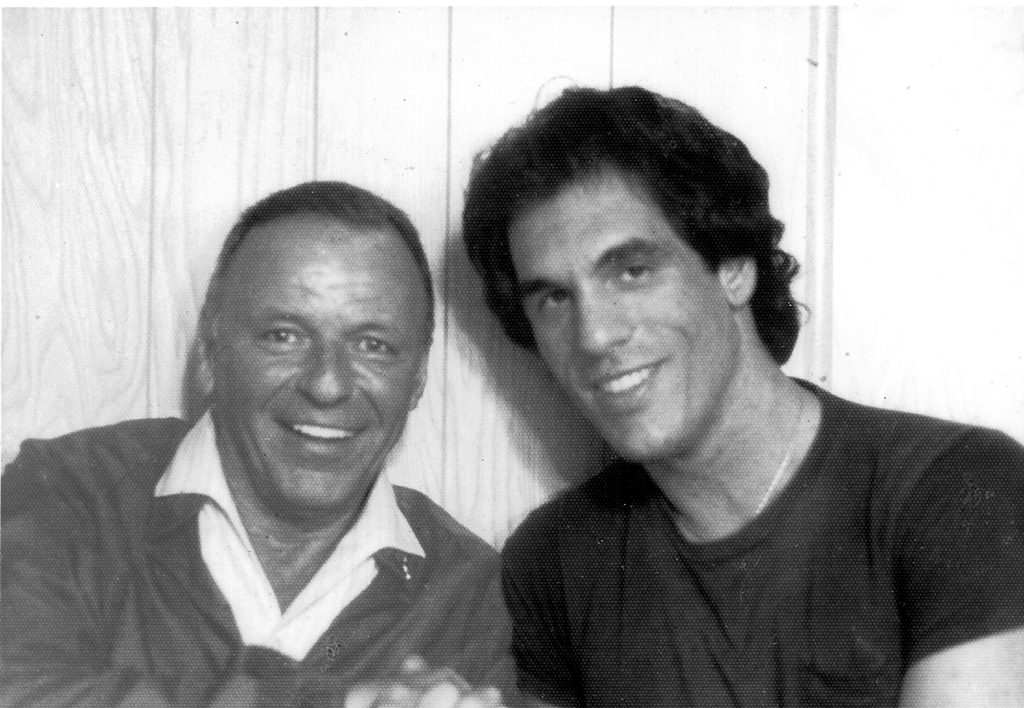
Frank Sinatra was an extraordinary artist—but before that, he was an extraordinary man. For us Italian Americans growing up, there were two figures: the Pope and Sinatra. And not necessarily in that order. He gave dignity to a community of immigrants that was not always respected. He gave us presence. He gave us a voice. At the time I was studying with Stella Adler and doing small jobs to pay for my acting and singing lessons. I also worked as a waiter in a restaurant in New York, but I was fired under… let’s say questionable circumstances. I was young, naive, just trying to survive. Then the opportunity for Contract on Cherry Street came along. It was Sinatra’s first film after years away from the screen. For me it was enormous. Sinatra saw the footage and came over to me on set. He said, “Yours is the most truthful performance in the film. You’re extraordinary.” For me, that meant everything. Then he noticed the scars on my neck and face and told me: “Don’t let them intimidate you. They’re part of your story. Wear them with pride.” That was mentorship—but more than that. It was something deeper. He gave you confidence. He made you feel comfortable in your own skin. One evening he invited me to dinner. We stopped right in front of the restaurant where I had been fired. We walked in together. The manager turned pale. Ten minutes later they handed me an envelope—my severance pay. Sinatra smiled. He didn’t say a word. He didn’t have to. He brought me to Los Angeles. He put me up at the Beverly Hills Hotel. He introduced me to everyone. I had never even been on a plane before. He made me feel like I belonged in that world. We often talked about opera and classical music. It was a passion we shared. And I’ll never forget: two in the morning in Little Italy. He looks at me and says:
“Robert, have a drink.”
“I don’t drink, Mr. Sinatra.”
“You don’t drink? You’re fired.”
So I had my first Jack Daniel’s with Sinatra in 1977. Two fingers of whiskey, four ice cubes, water. He said: “This will take you where you want to go without hurting you.” That was Frank. An immense figure—but deeply human.
Throughout your career, have your Italian roots been more of an advantage or a limitation?
The only limitation I encountered had nothing to do with being Italian, but with my appearance. Stella Adler told me from the start: “They will always give you the tough-guy role. Don’t let it define you. You’ll get beyond it—you’re a great actor.” I had a classical education. I graduated in acting, studied Shakespeare and poetry, always ready for very different roles. I never wanted to be labeled in only one way. Yes, I played powerful men and authoritarian figures—but also complex, layered roles across different genres. Being Italian American was never a disadvantage. If anything, it gave me identity. There was only one episode I remember in this sense. I was offered an important role in Blood In Blood Out, but there was resistance because I wasn’t Hispanic. It was disappointing. As actors, this is what we do: we transform. Andy Garcia isn’t Italian, yet he has played Italians. I’ve played all kinds of characters, including an Orthodox Jew, a Palestinian, the wizard Merlin, a Colombian drug trafficker. That’s the craft. The industry changes with time. Today there’s a different sensitivity around identity and casting. But the real question is simple: can the actor bring authenticity to the character? If the answer is yes, that’s what truly matters.
When you choose a project, what matters most: the role, the script, or the director?
It depends. It’s a combination of things. Sometimes it’s the role. Sometimes the script. Sometimes even the location. If I feel there’s a connection with a character—if there’s something new to explore—that’s already enough reason for me. I’ve never been afraid to work with first-time directors. Everyone starts somewhere. You never know who might bring something important out of the material. If the material interests me and I feel I can contribute something, I jump in. After the Bond film I was offered The Hunt for Red October. But in the end I chose to do a small independent film, shot over ten weeks in the Amazon rainforest, where I played a pilot involved in the world of gold prospectors. I didn’t know the director. But the experience intrigued me. The character, the adventure… I’ve always tried to alternate between big productions and independent films. Then came the series Profiler. That’s when the rhythm of things changed. Those were four important years, and I’m grateful for them. But television ties you down. There were films I unfortunately had to turn down because I couldn’t free myself from the shooting schedule. That’s part of the business. Even there, though, I stood my ground. The character was named Bailey Malone—Irish. After casting me, they wanted to change his name to something Italian. I said: “No, leave it as it is.” I never wanted to move in just one lane. In the end I choose by instinct. When I feel there’s something alive to discover, then it’s worth doing.
You have worked in major Hollywood productions, independent films, and television. What really changes when the scale of a project changes—and what doesn’t?
The biggest difference is in production time. In television you often have to shoot a certain number of pages per day. Everything is very organized, sometimes very fast. But it depends on the project. I’m currently working on Tulsa King with Sylvester Stallone. It’s a series, but it’s shot like a feature film. They take the time they need. They care about the framing, they cover the scene properly, they make sure it truly works before moving on. That’s a luxury. In independent films, on the other hand, you often have to run. Fewer resources, tighter schedules. But that doesn’t mean less value. In fact, sometimes there’s a rawness, an urgency, even a social dimension that you don’t always find in big productions. There’s something alive in that pressure. Big productions can take months—four, six, sometimes more. I remember doing fifteen takes for a scene with a director like Paul Verhoeven. Then you work with someone like Clint Eastwood and maybe he does one or two takes and that’s it. Different styles. Different rhythms. Neither guarantees the result. In the end, whether it’s a blockbuster or a small independent film, what matters is what’s in front of the camera: the story, the performance, the effect it leaves on the audience. The scale changes the organization, the resources, the timing. But the heart of the work remains the same.
Current and upcoming projects?
As I mentioned, I’m working on Tulsa King. It’s a fantastic experience. I play a very interesting character—and yes, a rather intimidating one. Beyond that, I have several films in development. I’m about to head to Oklahoma for a project titled Honor, and another film in production called The Jungle Rules. I recently finished Bad News on the Doorstep, shot in Rhode Island. It was a special project because my son Nick is one of the leads alongside Dante Palminteri, the son of Chazz Palminteri. Chazz and I are also in the film. It was meaningful for us to share that experience with our sons. Music continues to be an important part of my life. I have concerts scheduled in several countries and a new album coming out next year, which I will probably coordinate with the release of Tulsa King. And then there’s family. I have eight children—including a six-year-old daughter—so as you can imagine, I don’t get bored.
One last question… it’s an issue that has divided fans for more than thirty years: is Die Hard a Christmas movie or not?
A couple of years ago—maybe last year—I posted a photo on what used to be Twitter, now X. I was wearing a Santa hat and holding a white card that said: Die Hard is a Christmas movie. It got more than two million views. That made me think. When we shot it, I didn’t think of it that way at all. To me it was an action movie. But over time I started to see it differently. It takes place at Christmas. Bruce Willis is running barefoot, his feet bleeding… there’s almost a sacrificial element to it. Christmas isn’t just a backdrop—it’s part of the story, part of the emotion. I was in London at the Action Film Festival for a Q&A with John McTiernan. I even sang “Let It Snow” in front of about 1,200 people. At the end I said: “Die Hard is a Christmas movie.” The theater exploded. So yes, I changed my mind. Today I think it is. And every October, when they start airing it again and the debate begins, my IMDb ranking shoots up. And not only that… my royalties do too.