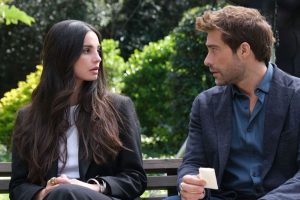
Fjord, the new film by Cristian Mungiu, was presented in competition at the 79th Cannes Film Festival, awarded with the Golden Palm. It is not a novelty for Romanian director to be hosted in the competitive section of the prestigious French event, nor much less get such remarkable prizes. Historically, festivalry environments, for themselves, are attentive observers of films from countries that are often shadowed by much longer and powerful cultural hegemonies, when not by their own intrusive governments. Mungiu, like so many fellow countrymen including Radu Jude, Calin Peter Netzer, Cristi Puiu, emerged precisely thanks to the Berlinale and Cannes: a generation daughter of the fall of the totalitarian regime of Nicolae Ceaușescu, who in his films often faces the social and political trauma of the dictatorship in Romania, and what remains today. Realism and the grotesque go hand in hand, in the minimalist cinematographic language, between long sequence planes, audio in direct grip and photographs for nothing eccentric, and in the derisory tones, that reveal longevous and facade conventions, when they do not explode in the most effered drama.
Cristian Mungiu, a native of Iași, born in 1968, is one of the most famous names of this new Romanian wave: he graduated in American literature and after the Academy of Theatre and Film of Bucharest he lives his first experiences as direct aid in titles such as Train de vie – A train to live (Radu Mihăileanu, 1998). In Fjord for the first time, it comes out from the borders of Romania, but only in the setting and part of the cast, since the country is always present in the background. It is Romanian the protagonist family Gheorghiu, fervent Christian evangelical, who moves into a fjord, in fact, in Norway, the country of origin of the mother (Renate Reinsve): their arrival will upset the liberal city that will have to confront the doubt that the educational methods of parents are dangerously rigid and violent.
OCCIDENT (2002)
The dream of the free and rich West, on the other hand, is often present in the filmography of the director, a cardinal point with which he titles his first feature film, after a series of short films. Occident (2002), presented at the Quinzaine des Réalisateurs in Cannes 55, is a tragicommedia composed of three episodes, in which young people fleeing Romania will discover sturgeons, slavery and too many compromises from which neither the New World is exempt.
LOST AND FOUND – Ep. Turkey Girl (2005)
In 2005 he participated in the collective film Lost and Found: six young directors of Central and Eastern Europe reflect on the concept of generation. Mungiu’s contribution, Turkey Girl, seems to anticipate the race against the time of the next feature film, as he tells of a daughter who to pay a necessary surgical operation to the mother must deliver a turkey to a doctor in Bucharest.
4 MESI, 3 SETTIMANE, 2 GIORNI (2007)
The official consecration, in fact, takes place with 4 months, 3 weeks, 2 days, winner of the Golden Palm in Cannes in 2007, one of the most famous titles of the new wave. Two young women fight clandestinely against Romania in Ceaușescu, facing an odyssey to succeed in abortion, a crime in 1987. Mungiu puts aside satire, saving nothing to the viewer, even the corpse of a fetus: the gray walls and skies, the sequence planes imprison the protagonists and the female gender everything, denouncing a barbaric control that took place until just under forty years ago.
RACCONTS OF THE WORLD AGE (2009)
In 2009 the collective work as the desacration, since its title. Tales of the golden age, as the totalitarian period was defined, is built in six episodes not specifically signed (together with Mungiu, among the authors include Han Höfer, Razvan Marculescu, Constantin Popescu and Ioana Uricaru). Once again, Romania is the protagonist and backdrop of an analysis under the lying spores of the fairy tale and legend, which exposes phrasesas and bureaucracies of an ignorant people and unable to rebel. It is presented in the Un Certain Regard section in Cannes.
OLTRE LE COLLINE (2012)
Beyond the hills is Mungiu’s most extensive film, and probably the most quirky, frighteningly drawn from facts really happened. It is not enough for the advent of the third millennium or the end of a regime to revive a retrograde and violent society. Rural campaigns, loneliness, oppressive religion are enemy of another couple of women, where one is increasingly free and braver than the other, but ultimately pays the anesthetic of life with death. In 2012 he won the Prix du scénario and the double prize for the best female interpretation in Cannes.
UN PADRE, UNA FIGLIA (2016)
Eliza’s diploma is at the top of his father Romeo’s thoughts and is also the original title of A father, a daughter, presented in competition at Cannes in 2016 and winner of the Prix de la mise en scène. Yet contemporary Romania and the lie founding society, which if on the one hand hates the corrupt system and in order to escape it always dreams of that West, is ready to remove bustarelle for its own personal tornaconto.
SELVATIC ANALYSIS (2022)
A speech on immigration already insinuates in the penultimate wild animals, presented in competition in Cannes in 2022. It is not the new Sinhalese community to really upset the small village of Transylvania where Matthias returned from Germany, to embrace family and lover, because the balance is already precarious of his, because society is full of hypocrisy, fears, discontent.
This is what films like Mungiu, starting from the specificity of the chronicle and history of his country, end up talking to anyone, all over Europe. Moving the first steps in the extreme realism of direct sequences, turn by hand and leaving little space to imagination, do school, mature, conquering sometimes even the genre. Instruments that bring out distortions and unresolved both of totalitarianism and of liberalism.
L’articolo The films of Cristian Mungiu proviene da SentieriSelvaggi.