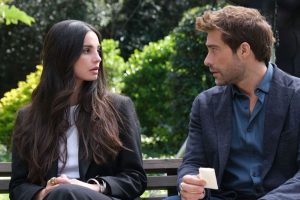
On November 13, Laura Samani retired the Sentieri Selvaggi prize for her second work One year of school. He is the youngest Italian director to have obtained the recognition dear to the editor, that since 2001 he has been honoring great names of Italian cinema and since 2016 is a public event. Among the winners we remember Mario Martone for Fuori last year, Alice Rohrwacher for La Chimera in 2023/24, Nanni Moretti for Il sol dell’Avvenire in the season 2022/23, Franco Maresco for La mafia is no longer that of once in 2019/2020, or Marco Bellocchio for Marx can wait, and Luca Guadagnino for the TV series We are who we are on the occasion of the 20th edition of the award.
For the occasion the director, winner of the David di Donatello for Piccolo corpo, who marked his debut, met the audience and editors to dialogue on the central themes and structure of his films. In particular, the meeting begins with a reflection on the process of making the award-winning film, adaptation of the autobiographical story by Giani Stuparich in 1929. “It’s a story that has accompanied me since I was the age of the protagonists. Before I even knew I wanted to make some films, I was going to fantasize about readings, imagine scenes giving physicality and nuances of character. I think this rewriting hypothesis has already started there. ”
Just like the author of the novel set the story in 1909, Samani decides to set the film in the past, precisely in the Trieste of 2007/2008, that is his last year of high school. A conscious decision to translate part of his life within the stories and dynamics of his characters. The story follows Fred, a 18-year-old Swedish, who moved to Trieste to follow his father. Integrating into a technical institute attended by males is not easy at all, but despite the unsolicited jokes and attentions, Fredrika will be able to fit into the exuberant trio of friends composed by Antero, Pasini and Mitis. Three divergent personalities and a seemingly indissoluble bond, which will experience the first imbalances just when they open their circle to a fourth person. As the director himself says, it would be better to talk about triangles.
The dialogue continues with a reflection on the management of the different registers in the long sequence shown, which includes both a choral moment, with the amorous triangle between Pasini, Antero and Fred, and an intimist element. More than registers, Laura Samani speaks of “geographic forms”. “The novel by Stuparich has a geometric fan shape, in which Fred (in the novel Edda) is the pivot and has independent relationships with each of the three boys. The trio no longer exists, because the arrival of her makes them move away. ” The film starts right from this “equilateral triangle”, in which the boys shoulder and complete, especially thanks to Mitis mediating between the other two, working for the potential eternity of the group. Fred’s arrival breaks the balances and “although they tend to become a square, they become a trapeze, something debilitating. ”
An adaptation is definitely a continuous compromise, first between author and reader or, as in this case, between writer and director. Authorial visions that collide and mix, to realize a project that “is not a solitary work” is the director. “One side must maintain fidelity, but on the other you must have sufficiency softness to make it feasible. In a year of school, for example, the script has undergone small variations, but has remained quite consistent with it from the beginning. The kiss scene between Antero and Fred at the border was thought of in another location.”.
This statement allows to introduce another reflection on the territory. “The initial location was a bus stop in Trieste called Luminosa due to the presence of a design neon panel, but it was removed and replaced by a led screen, losing all its charm of modernity that I liked. ” Despite the changes in the territory, they did not represent for the imagination of the director an obstacle, rather an opportunity of freedom. “What a luxury is to discover a place in your city where you have never gone, thanks to a movie,” he says about the school where the shooting took place.
“The true love story of the film is the group” continues, and this awareness comes precisely in the exciting choral scenes where all 4 protagonists are present. Despite at first the trio seems to be the protagonist and the girl a mere spectator, the film path gives centrality to Fred’s body, especially in the final scene, in which, in a speculative way at first, the mdp turns a backward path leaving the school. Laura Samani welcomes Carlo Valeri’s reflections, although “he had never conceived the film as a matter of body, as a passage from being subject to subject. ” The final scene spreads on the notes of a Prozac+ song that, in this sense, is an extra script page. “We didn’t just hold it, but we stretched it. In the original version there is not even the contribution of singer Elisa Toffoli. It seems to have been written for the film.” Entering a female voice was therefore fundamental to give legitimacy to Fred’s change of perspective become subject.
The conversation changes direction, moving on Small body, opening a reflection on the relationship with the landscape. The night seems to be preferred by the director, especially in this film in which he employs a completely natural light, derived more than anything else from the “orthodoxes of the beginning”, in which we have the idea of making a cinema with precise characteristics. Approach that made it useless for his second film: “Why make a film with natural light when there was a lot of neon light at school? I don’t like it when the technique hinders the human, I don’t find that the aesthetic result is worth the feeling that produces me.”.
A director who does not incasella within a specific genre, but who loves to experiment and contradict himself, without swearing eternal fidelity to the insights of the first projects. “It is important to remain porous compared to the needs we have as human beings and not as artists. It makes sense to give space and legitimacy to their needs in investigating a story.” ”
Mario Martone, the last winner, who symbolically passes her witness, celebrates the moment with a big hug and applause from the public.
The article Sentieri Selvaggi 25/26 a Un anno di scuola. Meeting with Laura Samani comes from SentieriSelvaggi.
.