It is a flourishing moment for Stephen King on TV, especially with the adaptations of his stories of innocence. After Welcome to Derry and Carrie, another title is The Institute. The first season is in replica every Saturday on Sky Atlantic and NOW while the second is on the air every Sunday on MGM+ (channel of Prime Video and Infinity).
Luke Ellis, a 14-year-old genius, is kidnapped in the middle of the night and brought to the Institute, a prison-like structure located in the Maine countryside, which houses children with psychic powers. To direct the place is Mrs. Sigsby, a wise and determined woman, fanatically convinced of her mission and willing to do everything to complete it. Between Sigsby and Luke immediately a deadly struggle, made of will and cunning clashes.
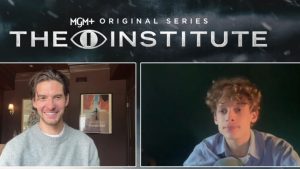
The series, directed by Jack Bender and developed by Benjamin Cavell, drags spectators into a dark and suspense universe, where nothing is as it seems and the boundary between power, fear and freedom becomes increasingly subtle. We talked about it with Ben Barnes (Tim Jamieson), a policeman who becomes a sort of putative father for the protagonists and wants to save them and denounce the institute at all costs, and Joe Freeman (Luke Ellis), the “genio” of the rebel group.
The Institute, intervista a Ben Barnes e Joe Freeman
The series offers a serious dilemma. What are we willing to sacrifice in the name of the greater good and who decides what is the greater good? Have you asked these questions during the shooting? And what did you say?
Ben Barnes: I think it’s impossible to work on any kind of Stephen King’s adaptation without questioning. He is so deeply concerned to question the strong powers and fight against abuses of power, status, hierarchy and money. I think he always has a quality: the core of his type of narrative is to leave power to young people, in this case, literally superpowers. Remembering that it is the next generation to have power.
And so I think this kind of thoughts and conversation is natural. But when you’re turning, you’re playing a character who has relationships and deeply cares about other characters and is motivated by the feelings he feels about the protection of those he loves. And therefore, he wants to do the right thing for the most people, but also take care of the people he cares about. Like a lot of that tension comes from there, I think.
Your characters are both leaders in a way against the Institute. What do you think it means to be a leader today? What features should it have and what should not have a leader?
Joe Freeman: I suppose it depends on where you are in the world. I think a leader should be someone who just doesn’t want to disclose but also receive. Like you listen to people because you don’t live the way they live. The key is listening. I think this is the most important feature. Being able to admit a mistake or still know when you are wrong, and be able to listen to people.
Ben Barnes: I think my answer is exactly the same. I was thinking about this in terms of what makes a director valid on a movie set. It’s someone who has a very clear vision. Someone who can see the full picture and thought about every possibility. Someone who knows what the goal is and has a clear vision of everything and is able to put order and direct the works. He is informed enough that he can answer any questions about that project. But he is also willing to listen and understand when the best idea is not his. In order to implement that idea and also be able to say “I don’t know”. I think we have this false conviction that a true leader, whether he is a group of friends or a political leader, that being able to say “I don’t know” is always a weakness. It’s not.
You have appointed young people before, who are central in this story. Why do you think children and teens have that more in horror stories and thrillers like this?
Joe Freeman: I think the idea of fear arises from those who suffer evil. Obviously, any atrocities committed against someone is a bad thing. But when you’re looking at something that isn’t real, you’d be much more afraid to see it happen to a child rather than an adult. That’s why I didn’t really like the second It movie where the protagonists grew up. I didn’t find it scary. But yes, Stephen King is very good at putting children at the center of attention. It is not even a horror story at the bottom.
Ben Barnes: This is corruption of innocence, loss of innocence.
The article The Institute, interview with Ben Barnes and Joe Freeman: “Horror with children is scarier” comes from Dituttounpop.it.