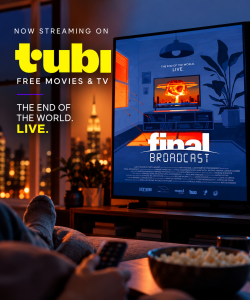
There is something both ridiculous and disturbingly plausible about the premise of Final Broadcast: nuclear annihilation is apparently minutes away, yet somewhere in America a television network is still on the air, complete with anchors, experts, field reporters, survival advice and, inevitably, commercials. The world may be ending, but nobody has canceled the programming schedule.
Now available on Tubi, the free, ad-supported streaming service, Final Broadcast is an odd little independent movie, and not an entirely easy one to recommend. Shot in just three days, it frequently looks like it. The budget is visible, the performances can be uneven, some exchanges go on longer than they should, and the deliberately artificial quality of the television studio occasionally crosses the line from satire into something that simply feels awkward. At roughly 86 minutes, there are moments when the central conceit seems better suited to a short film than a feature.
The reaction from viewers has been similarly unforgiving. Its IMDb user rating is low, and it isn’t difficult to understand why. Anyone approaching Final Broadcast expecting a conventional nuclear thriller, or even the narrative momentum of a typical low-budget genre movie, is likely to be disappointed. Very little happens in the way we have been trained to expect things to happen in movies about the end of the world.
But that is also where the film becomes harder to dismiss.
Director Davide Ippolito is considerably less interested in the apocalypse than in the people describing it. His target isn’t nuclear war itself but the strange machinery that turns every event, no matter how serious, into television. Inside the fictional Broadcast World Crisis network, frightened people share airtime with skeptics, commentators continue commenting, experts offer advice and advertisers apparently see no reason to stop selling things. Outside, reporters encounter a reality increasingly at odds with the strangely reassuring order of the studio.
The joke is obvious. What gives it weight is how recognizable it has become.
We have grown accustomed to consuming wars, natural disasters, political violence and environmental emergencies through the same screens on which we watch sports, comedy, influencers and commercials. Terrible images appear, experts explain them, panels argue over them, audiences divide into camps and, eventually, the algorithm moves on to something else. Final Broadcast takes that familiar process and pushes it to its most absurd conclusion: what if the media could process even the end of civilization without ever breaking format?
The film is at its best when it trusts that idea and doesn’t try too hard to underline it. Some of its funniest moments come from the sheer normality of the broadcast. The fact that commercials continue to exist while nuclear destruction approaches is funnier, and more pointed, than any speech about media responsibility could be. The contrast between what is happening outside and the almost cheerful professionalism inside the studio gives the movie its most effective satirical edge.
Its limitations, oddly, sometimes work in its favor. The cheapness and artificiality of the television environment can make the whole thing feel like a transmission from some alternate version of local television rather than a polished Hollywood reconstruction of one. There is an immediacy to it that a larger production might have lost. At other times, however, a limitation is simply a limitation, and the film would benefit from tighter editing and greater consistency among its performances.
This makes Final Broadcast one of those independent movies where separating intention from execution becomes part of the viewing experience. Not everything works, and the film doesn’t earn every minute of its running time. But it is trying to do something more interesting than simply reproduce a familiar genre with less money.
There is also an accidental irony to its arrival on Tubi. A movie in which the apocalypse itself becomes programming can now be watched free on an advertising-supported platform, potentially interrupted by the very thing it spends much of its running time mocking. It’s difficult to imagine a more appropriate way to see it.
Whether Final Broadcast is ultimately a successful experiment will probably depend on how much patience a viewer has for its roughness. The negative reactions aren’t inexplicable, and some of the criticisms are deserved. But a low-budget movie with an imperfect execution can still contain a very good idea, and this one does.
More importantly, it’s an idea that feels more relevant now than it probably has any right to.
Final Broadcast isn’t a great disaster movie, and it doesn’t really want to be one. It’s a messy, sometimes funny, sometimes frustrating media satire built around a question worth spending 86 minutes with: if the world really were ending, would our screens finally turn off, or would we simply keep watching?
For all its flaws, that makes it worth watching.
m.f.